
Last Updated on March 21, 2021
It is vital to know sheet cake pan sizes and servings since determining them allow you to check how much you can get out of the sheet cake. Essentially, sheet cakes are excellent to make for a crowd. It easy to transport and do not need structural or layering support.
However, it cannot be easy to figure out which sheet cake size is appropriate for a certain event. That is why it is indeed a huge advantage to know the number of servings per sheet cake. Keep in mind that you should measure sheet cake pans in length, width, and height. Likewise, height or depth ranges between one and four inches. Hence, size is more important than the sheet cake pans’ style or material whenever shopping.
Sheet Cake Pan Sizes and Servings
Generally, the most appropriate sizes for every portion are 2″ x 3″ or 2″ x 2″ pieces. For this reason, deciding how big each piece should be is the first step in knowing the servings’ quantity or how much you can get out of the sheet cake. Moreover, it is significant to keep in mind the sheet cake pan’s depth, especially when making a single-layer or double-layered cake. In addition to that, you can utilize two shallow pans to bake two thinner cakes. Likewise, you can utilize a deep pan to make a tall cake. Hence, you can cut it into layers once it cools. Thus, all of these approaches are best when creating numerous layers.
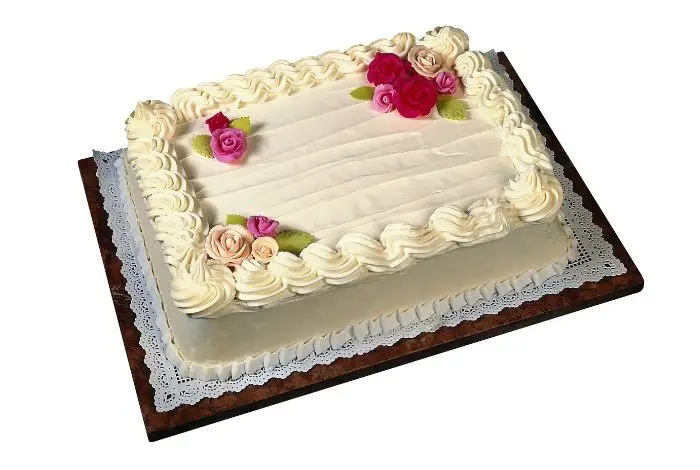
For a Quarter Sheet Cake Size
- 13″ x 8″ x 3″ – Sixteen servings if serving size is 2″ x 3″ and 24 servings if serving size is 2″ x 2.”
- 13″ x 9″ x 2″ – Nineteen servings if serving size is 2″ x 3″ and 29 servings if serving size is 2″ x 2.”
- 13″ x 9.5″ x 1″ – Twenty servings if serving size is 2″ x 3″ and 30 servings if serving size is 2″ x 2.”
For a Half Sheet Cake
- 12″ x 18″ x 2″ – Thirty-six servings if serving size is 2″ x 3″ and 54 servings if serving size is 2″ x 2.”
- 12″ x 16″ x 3″ – Thirty-two servings if serving size is 2″ x 3″ and 48 servings if serving size is 2″ x 2.”
- 18″ x 13″ x 1″ – Thirty-nine servings if serving size is 2″ x 3″ and 58 servings if serving size is 2″ x 2.”
For a Full Sheet Cake
- 16″ x 24″ x 3″ – Sixty-four servings if serving size is 2″ x 3″ and 96 servings if serving size is 2″ x 2.”
- 18″ x 24″ x 2″ – Seventy-two servings if serving size is 2″ x 3″ and 108 servings if serving size is 2″ x 2.”
- 18″ x 26″ x 2″ – Seventy-eight servings if serving size is 2″ x 3″ and 117 servings if serving size is 2″ x 2.”
Read about Two-Tiered Cake Sizes
Things to Consider When Buying Sheet Cake Pans
Looking for the best sheet cake pan is hard work. That is why it would help if you had a sheet cake pan that is easy to clean, affordable, and long-lasting. Most importantly, it should heat equally, however, does not warp in the oven.
Joho Baking Deep Baking Pans Nonstick Set

Material and Heat Distribution
First and foremost, avoid purchasing stainless steel and aluminum steel since they have uneven heat distribution. It would be best if you bought bare aluminum because it performs well in heat conduction. In addition to that, it heats up and cools down quickly. For this reason, it begins baking when it goes into the hot oven. Then, stops baking when it comes out. Moreover, it gives you more control over how brown the bottom of the sheet cake will be, so it provides an excellent light color result.
Do you want to know Why Do Cakes Fall When Cooling?
Alphabet Cake Pan
It is an amazingly multipurpose cake pan that you can utilize for numbers and letters. Also, you can use it to create odd-sized rectangles.
Parrish Magic Line Pans
The best thing about it is that it comprises all traditional cake pans, especially sheet cake pans. Because of this, it consists of high-quality cake pans that can indeed bake evenly. In addition to that, it does not warp despite using it in the oven countless times since it is long-lasting. Moreover, it has sharp corners for sheet cakes.
Nordic Ware Commercial Sheet Pans
Compared to traditional cake pans, it is not commonly utilized for layer or tiered cakes instead for jelly roll cakes. Also, it does not have sharp or straight up and down corners. Likewise, they are approximately two to three inches to an inch deep. Moreover, it comes in full sheet sizes, half-sheet sizes, and quarter sheet sizes.
How to Take Cake off Sheet Cake Pans
The best way to clean sheet cake pans is with soapy, hot water. With that, rinse properly. Then, please put it back in the oven. Doing this ensures that the oven’s residual heat will dry the sheet cake pan entirely before you store them. Likewise, you can reheat the oven to approximately 100 degrees Celsius if the oven has cooled.

Zarah is an experienced pastry chef whose creations have delighted countless customers. With a passion for baking, Zarah has developed a unique style that combines classic techniques with modern flavors. Her desserts are consistently crafted with the finest ingredients, and her attention to detail is evident in the stunning and delectable results. Zarah has a wealth of experience in the pastry kitchen, and loves to share her knowledge with others. Whether it is teaching a class or creating a custom cake for a special occasion, Zarah is committed to making sure every customer is satisfied.